Blow pressure, bottle format, line speed and reject rate create a different engineering boundary from instruments, filling valves and packaging air.
Food & beverage integrated-energy audit example
Carbonated soft drink bottling plant: electricity, heat and demand diagnosed together.
This case shows how a beverage plant should be screened as one integrated-energy system, not as separate air, cooling and boiler calculators.
- Separates low-pressure plant air from high-pressure PET blow air.
- Reports refrigeration electricity savings and condenser heat recovery as different benefit streams.
- Shows food-safety boundary for CIP preheating through sanitary isolation.
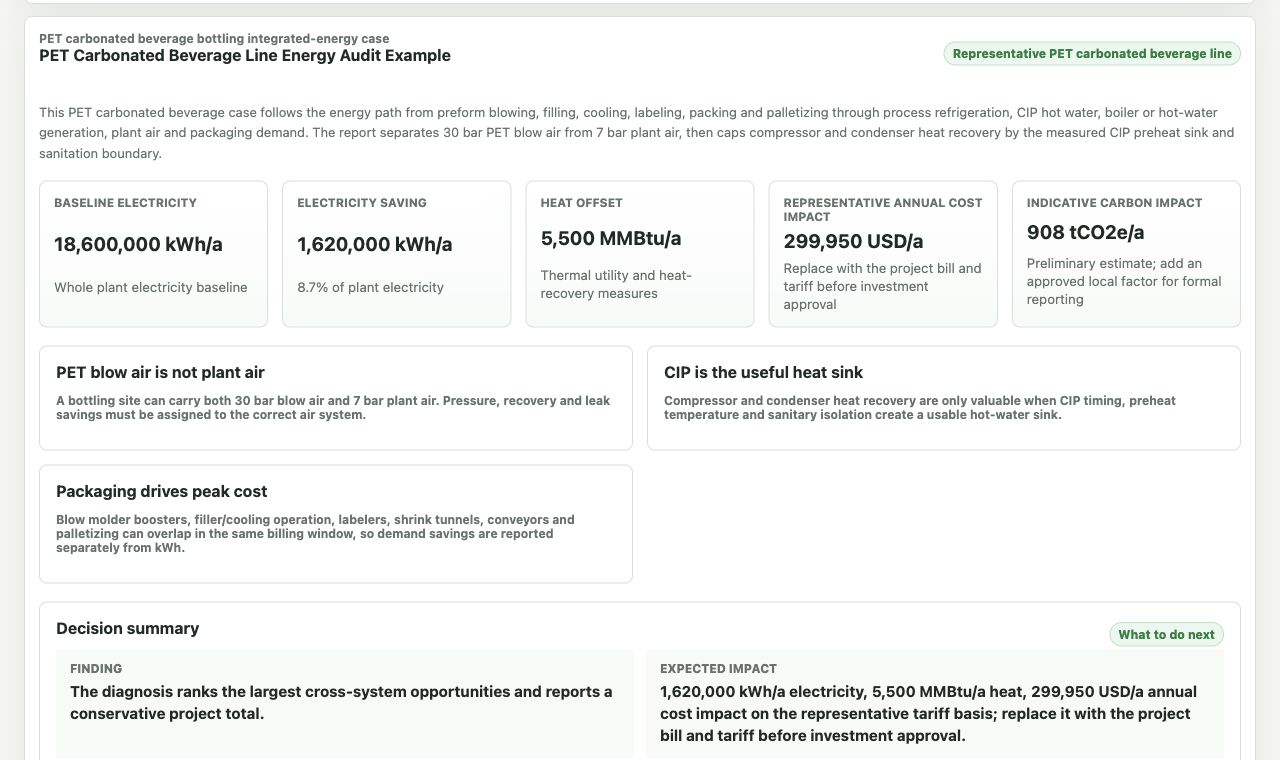
Actual diagnosis output
Plant air, PET blow air, refrigeration and process heat in one decision view.
The report separates each benefit stream and shows the site data required before investment use.
Why this case is different
A bottling plant has two compressed-air worlds.
A single 7 bar compressed-air model is not enough when the plant has PET blow molding. The case separates utility air and high-pressure blow air before adding refrigeration, CIP heat and electrical demand.
Recovered heat is modeled only as preheating through an isolated utility loop and sanitary heat exchanger.
Electricity reduction, condenser heat recovery and demand-charge impact are split so the report does not double count benefits.
Pressure, leakage and sequencing for filling valves, instruments and packaging users.
Blow pressure, air recovery and bottle-quality constraints are handled separately.
Condensing temperature and low-load control are quantified as electricity savings.
Compressor and condenser heat recovery is capped by CIP preheating demand.
Combustion tuning, condensate return and insulation remain thermal-side measures.
Demand-charge savings are separated from kWh savings and shown transparently.
Energy-flow map
The case is diagnosed as one plant, not six isolated utilities.
The diagram shows why the report separates physical electricity savings, thermal offsets and demand-charge impact before adding them to the project view.
Filling, packaging, bottle quality, sanitation and shift schedule define the energy boundary.
Pressure reset, leakage and sequencing are quantified as kWh savings.
Separated from plant air because bottle format, line speed and reject rate control the feasible target.
Condensing temperature and low-load control create the largest electricity-saving block.
Compressor and condenser heat can offset fuel only up to measured CIP preheating demand.
Thermal measures are reported separately from refrigeration and compressed-air kWh savings.
Demand-charge impact is calculated separately from physical electricity reduction.
Diagnosis result
What the example assessment produces.
The workflow uses a representative engineering data package for a warm-humid region bottling plant with two PET lines and one can line.
Measure
Annual impact
Engineering boundary
Implementation
Low-pressure plant air optimization
360,000 kWh/a and US$43,200/a.
Pressure, leakage and sequencing for utility air only.
Low to medium complexity; can often begin with controls and leak checks before any production shutdown.
High-pressure PET blow-air optimization
260,000 kWh/a and US$31,200/a.
Requires bottle format, line speed and reject-rate validation.
Medium complexity; short line trials by bottle format.
Refrigeration control optimization
720,000 kWh/a and US$86,400/a.
Condensing temperature, low-load hours and chilled circuit boundary.
Low to medium complexity; control tuning and trend validation.
Heat recovery and boiler measures
5,500 MMBtu/a and US$46,750/a.
CIP preheating, boiler tuning and distribution losses are capped to avoid double counting.
Medium to high complexity; sanitary tie-in and utility maintenance window required.
Demand management
280,000 kWh/a plus US$58,800/a demand-charge impact.
Energy and demand cost are split instead of being hidden in one savings number.
Medium complexity; requires operations agreement on shiftable loads.
Use the demo
Open the full case in the energy assessment.
Reference-backed method
Public method references behind this bottling case.
These references are used as method context for audit structure, system boundaries, evidence quality and M&V planning. They do not confirm site savings; the workflow still requires site data before investment use.
Reference familyHow it supports this case
ISO 50002 / ISO 50001
Energy-audit structure, evidence labels, M&V path and reportable findings.
DOE compressed-air system guidance
Pressure, leakage, sequencing and end-use review for plant air and high-pressure blow air.
DOE steam and process-heating sourcebooks
Boiler, hot-water, CIP preheat and useful heat-sink screening.
Before running the workflow
What a bottling user can judge before running the workflow.
This page shows the industry-specific signals used in the detailed diagnosis report, so a visitor can judge relevance before entering site data.
Visible signalWhat it tells the user
Process signal
Bottle format, preform weight, line speed and reject rate are visible constraints for blow-pressure optimization.
Energy signal
PET blow air is separated from low-pressure plant air and from refrigeration/CIP heat recovery.
Boundary signal
CIP heat recovery is capped by recipe timing, sanitary isolation and final validation.
Use this case as the first food and beverage audit benchmark.
Start from the bottling plant workflow, then replace the sample values with your own site boundary.