Milk temperature, receiving schedule and storage tanks establish refrigeration base load before production starts.
Dairy processing integrated-energy audit example
Pasteurization, refrigeration, CIP hot water and cold storage diagnosed as one dairy energy system.
This case shows how a dairy processing facility should be reviewed from the process boundary first: raw milk cooling, pasteurization, product cooling, chilled storage, CIP hot water, boilers, compressed air and electrical demand.
- Starts from dairy process operations before estimating savings.
- Separates refrigeration electricity, thermal fuel reduction and heat-recovery offsets.
- Protects the sanitary boundary for CIP and pasteurization temperature validation.
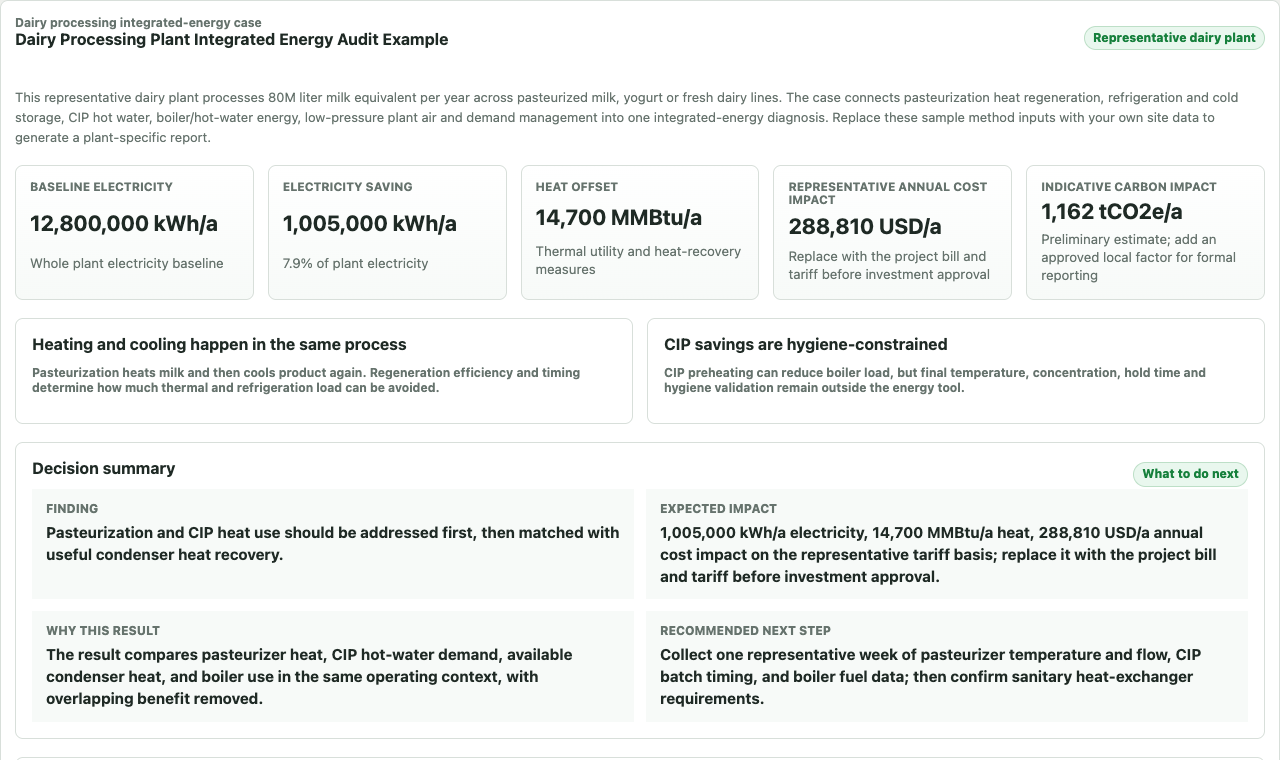
Actual diagnosis output
One customer-facing result across refrigeration, process heat and CIP.
Representative values are clearly labeled, overlap is controlled, and the next site-data action is visible before report download.
Method video
Why dairy heat-recovery savings are often double-counted
This engineering walkthrough explains how to audit pasteurization, refrigeration, CIP hot water, boilers, compressed air and heat recovery as one dairy energy system. It uses representative example values only; site-specific plant data should replace the sample inputs before project decisions.
Dairy audit method video
Process boundary, heat recovery and double-counting control
Watch the method first, then open the example workflow and replace sample values with site-specific plant data.
Process boundary first
Dairy energy opportunities come from heating and cooling the same product stream.
A dairy case cannot be treated as a generic refrigeration or boiler calculation. Pasteurization regeneration, product cooling, CIP hot water, cold storage and sanitary operation define what can be saved and what must be validated on site.
Pasteurization and plate heat-exchanger regeneration determine both hot utility demand and downstream cooling load.
Yogurt or fresh dairy batches can add temperature-control windows that interact with refrigeration staging.
Valves, instruments, packaging and filling air create a secondary compressed-air opportunity with reliability constraints.
Cold-room temperature, doors, defrost and storage turnover keep refrigeration running outside production hours.
CIP hot-water timing and temperature cap how much condenser or compressor heat can be reused.
Energy-flow map
The report keeps refrigeration, heat recovery and sanitary hot water separate.
The plant may need heat and cooling in the same production window. The report separates physical electricity savings, fuel reduction, avoided heat utility and demand-charge effects before showing the project total.
Product safety and cold-chain quality define which energy measures are acceptable.
Evaporating temperature, condenser control, cold-room doors and low-load sequencing drive electricity savings.
Plate heat-exchanger effectiveness and CIP hot-water demand set the thermal target gap.
Combustion, return temperature, condensate or hot-water loop losses remain thermal-side measures.
Pressure, leakage and dryer losses are reviewed as secondary electricity measures.
Peak coordination is shown separately from kWh reduction.
Recovered heat can preheat utility water only within the validated sanitary boundary.
Diagnosis result structure
What the dairy workflow produces.
The assessment maps the dairy process into the same pre-audit report structure used across kWhScan: baseline, target gap, equipment, controls, distribution, multi-energy boundary, measure priority and M&V.
Measure group
Why it matters in dairy
Energy boundary
Data to improve confidence
Refrigeration control and cold-room operation
Product cooling and chilled storage often continue beyond packaging hours.
Electricity saving from refrigeration controls and distribution losses.
Refrigeration trend data, cold-room temperature and door/defrost logs.
Pasteurizer regeneration and thermal recovery
Heating and cooling the same product stream makes regeneration performance critical.
Fuel reduction and cooling-load interaction shown with overlap control.
Pasteurizer temperatures, flow, regeneration approach and heat-source data.
CIP hot-water and condenser heat recovery
CIP creates concentrated hot-water demand windows that can use recovered heat.
Separate thermal offset capped by actual hot-water preheat demand.
CIP schedule, hot-water volume, temperature and utility loop design.
Boiler, hot-water loop and distribution losses
Combustion, return temperature, standby and pipe losses affect process heat cost.
Fuel-side savings, not mixed with refrigeration electricity.
Boiler efficiency, stack temperature, return temperature and operating logs.
Compressed air pressure and leakage review
Valves, filling, packaging and instruments need reliable dry air but usually not excessive pressure.
Secondary electricity saving with reliability and air-quality constraints.
Station power, pressure trend, dryer type and leakage survey.
Evidence basis
Public references support the process-energy boundary.
The page does not rely on a named customer logo. It exposes the engineering basis: public dairy energy references, equipment behavior, report calculations and user-replaceable site values.
Used to support the presence of material refrigeration, process heat, motor and utility opportunities in dairy facilities.
Open public referenceWhere the public page shows opportunity logic, the assessment report labels confidence and lists the data needed to improve precision.
The workflow is designed for utility bills, operating hours, equipment data and optional trend logs from the user's own site.
Use the dairy workflow
Open the full dairy processing case in the energy assessment.
Reference-backed method
Public method references behind this dairy case.
These references are used as method context for audit structure, system boundaries, evidence quality and M&V planning. They do not confirm site savings; the workflow still requires site data before investment use.
Reference familyHow it supports this case
ISO 50002 / ISO 50001
Energy-audit structure, boundary definition, evidence level and report logic.
Dairy processing energy guides
Pasteurization regeneration, refrigeration, CIP hot water and boiler utility review.
DOE steam / process-heating / compressed-air guidance
Fuel, condensate, heat recovery, pressure, leakage and sequencing method context.
Before running the workflow
What a dairy user can judge before running the workflow.
This page shows the industry-specific signals used in the detailed diagnosis report, so a visitor can judge relevance before entering site data.
Visible signalWhat it tells the user
Process signal
PHE approach temperature, fouling, product flow and regeneration outlet temperature are named before heat-recovery savings.
Energy signal
Refrigeration, CIP hot water, boiler fuel and plant air are separated before totals are added.
Boundary signal
CIP and pasteurization validation stay outside the energy-saving claim.
Use this case as the dairy processing audit starting point.
Start from the dairy processing workflow, then replace the values with your own plant data and unlock the full report if the result is useful.