Warm product, forklift movement and open dock doors create sensible and latent refrigeration load before goods enter storage.
Cold storage warehouse integrated-energy audit example
Frozen rooms, chilled docks, door infiltration and refrigeration controls diagnosed as one cold-chain system.
This case starts from how a refrigerated warehouse operates: receiving, staging, frozen storage, chilled zones, order picking, dispatch docks, door traffic, defrost and the compressor room.
- Separates frozen rooms, chilled rooms and dock/staging areas before calculating savings.
- Reports compressor kWh, fan heat, defrost heat and demand-charge impact as different benefit streams.
- Keeps every control recommendation inside product-temperature and cold-chain operating limits.
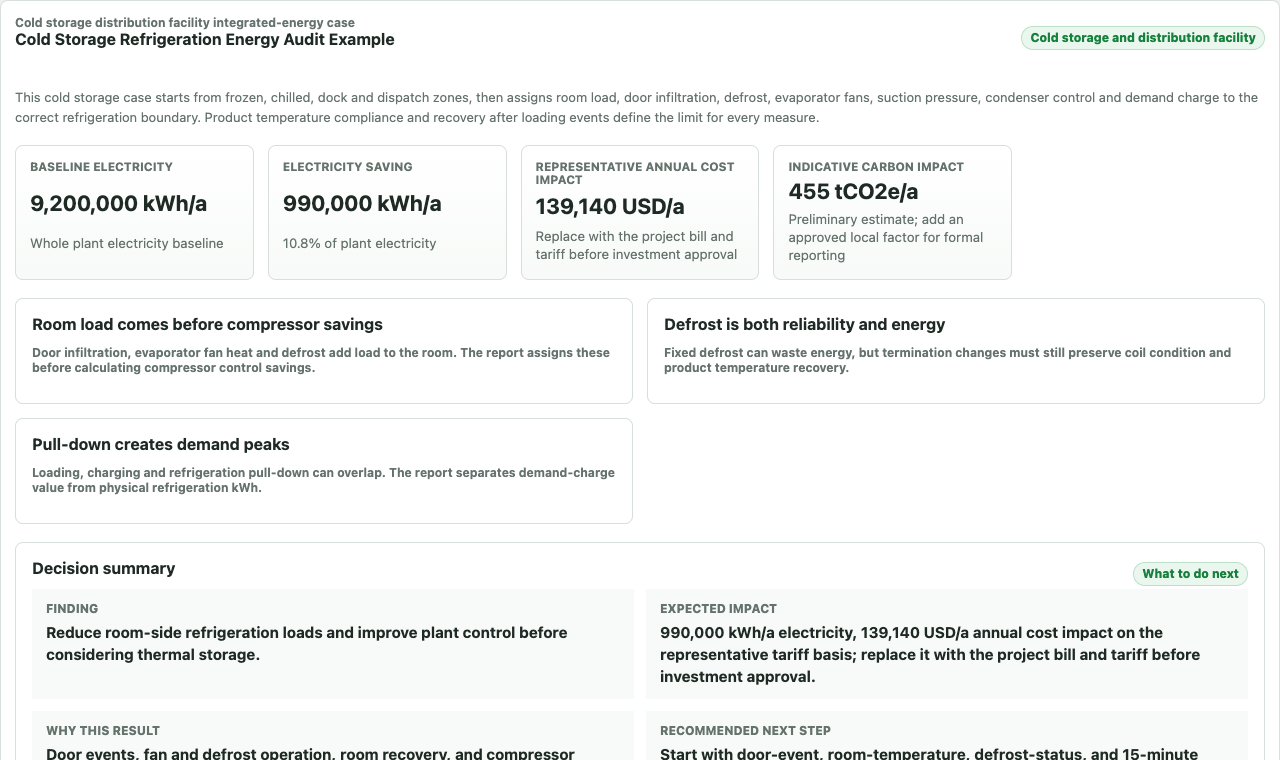
Actual diagnosis output
Frozen rooms, docks, defrost and demand translated into one result.
The report separates energy streams and shows the operating evidence needed before a warehouse investment decision.
Warehouse boundary first
Cold storage savings depend on what enters the room and when it must be removed.
A cold storage case cannot be reduced to compressor efficiency alone. Door traffic, dock temperature, moisture infiltration, defrost heat, fan heat, product pull-down and demand charges define the diagnosis boundary.
Low-temperature rooms magnify suction-pressure, evaporator airflow, door leakage and defrost decisions.
Medium-temperature rooms may carry different suction groups, room targets and product-temperature constraints.
Open duration, vestibules, dock seals and traffic discipline become refrigeration measures because infiltration becomes compressor load.
Defrost heat and fan heat both become cooling load after they perform their control function.
Suction pressure, floating head pressure, condenser fan control and compressor staging define the main electrical opportunity.
Energy-flow map
The report separates room load, plant efficiency and demand timing.
The diagram keeps physical kWh reduction, avoided re-cooling, fan heat reduction and demand-charge impact separate before showing the project view.
Shift schedule, product movement and room zoning define the refrigeration boundary.
Compressor kWh falls when suction, condensing and staging controls are improved within temperature limits.
Door behavior becomes compressor load, evaporator frost and more frequent defrost.
Unnecessary defrost adds heat that the refrigeration plant must remove again.
Fan control savings are counted once, with secondary cooling-load interaction disclosed separately.
Demand-charge impact is split from physical electricity savings.
Load shifting and setpoint changes remain inside the product-temperature envelope.
Diagnosis result structure
What the cold storage workflow produces.
The assessment maps the warehouse into the same pre-audit report structure used across kWhScan: baseline, target gap, equipment, controls, distribution/end-use, demand view, measure priority and M&V.
Measure group
Why it matters in cold storage
Energy boundary
Data to improve confidence
Floating head pressure and condenser control
Compressor lift changes with outdoor conditions and condenser performance.
Compressor kWh reduction, separated from condenser fan energy.
Condensing pressure, ambient temperature, condenser fan status and compressor power.
Suction pressure and room-temperature control
Low-temperature rooms are sensitive to suction pressure and evaporator approach.
Refrigeration electricity saving within product-temperature limits.
Room temperature trend, suction pressure, product class and pull-down events.
Door and dock infiltration control
Door open time brings warm, moist air into the refrigerated space.
Reduced refrigeration load, frost and defrost frequency.
Door logs, dock schedule, vestibule condition and evaporator frost history.
Defrost optimization
Timed defrost can add heat when coils do not need it.
Reduced heater energy and reduced re-cooling load, with overlap control.
Defrost start time, duration, termination method, coil temperature and room recovery time.
Demand management and load shifting
Cold storage can have material demand-charge exposure, but product temperature limits control the feasible window.
Demand-charge impact shown separately from physical kWh reduction.
Utility interval data, room temperature trend, compressor status and tariff structure.
Evidence basis
Public references support the cold-storage energy boundary.
The page exposes the engineering basis instead of relying on a named customer logo: refrigerated warehouse code guidance, industrial cold-storage load research, warehouse benchmarking context and refrigeration efficiency resources.
Used to support insulation, infiltration barriers, evaporator fan controls, condenser efficiency and compressor variable-speed boundaries.
Open public referenceUsed to support the role of cold storage as a major electricity load and the need to respect product-temperature limits in load shifting.
Open public referenceUsed to frame refrigerated warehouses and distribution centers as a recognized building-energy category.
Open public referenceUse the cold storage workflow
Open the full cold storage case in the energy assessment.
Reference-backed method
Public method references behind this cold-storage case.
These references are used as method context for audit structure, system boundaries, evidence quality and M&V planning. They do not confirm site savings; the workflow still requires site data before investment use.
Reference familyHow it supports this case
ISO 50002 / ISO 50001
Audit boundary, energy baseline, evidence level and M&V structure.
ASHRAE refrigeration resources
Refrigerated facility design, product handling, heat loads and refrigeration-system context.
DOE fan, motor and industrial system guidance
Evaporator fans, condenser fans, motors and demand-side support loads.
Before running the workflow
What a cold-storage user can judge before running the workflow.
This page shows the industry-specific signals used in the detailed diagnosis report, so a visitor can judge relevance before entering site data.
Visible signalWhat it tells the user
Process signal
Frozen rooms, chilled rooms and dock zones are separated before compressor savings.
Energy signal
Door infiltration, defrost and evaporator fan heat are assigned as load-side effects.
Boundary signal
Product temperature and room recovery time gate every door and defrost measure.
Use this case as the first cold-chain audit benchmark.
Start from the cold storage workflow, then replace the sample values with your own room zones, door logs, refrigeration trends and utility data.