Bath ratio and temperature define heat demand.
Textile dyeing integrated-energy audit example
Dyeing, washing, drying, wastewater heat and steam diagnosed as one wet-processing energy system.
This case starts from batch wet processing: bath ratio, dyeing temperature, rinse/wash stages, dryers/stenters, hot wastewater, boiler steam and compressed air.
- Separates boiler fuel, wastewater heat, exhaust heat, pump/fan electricity and compressed air.
- Caps heat recovery by useful heat sinks and fouling constraints.
- Keeps color quality, chemistry and batch timing as process boundaries.
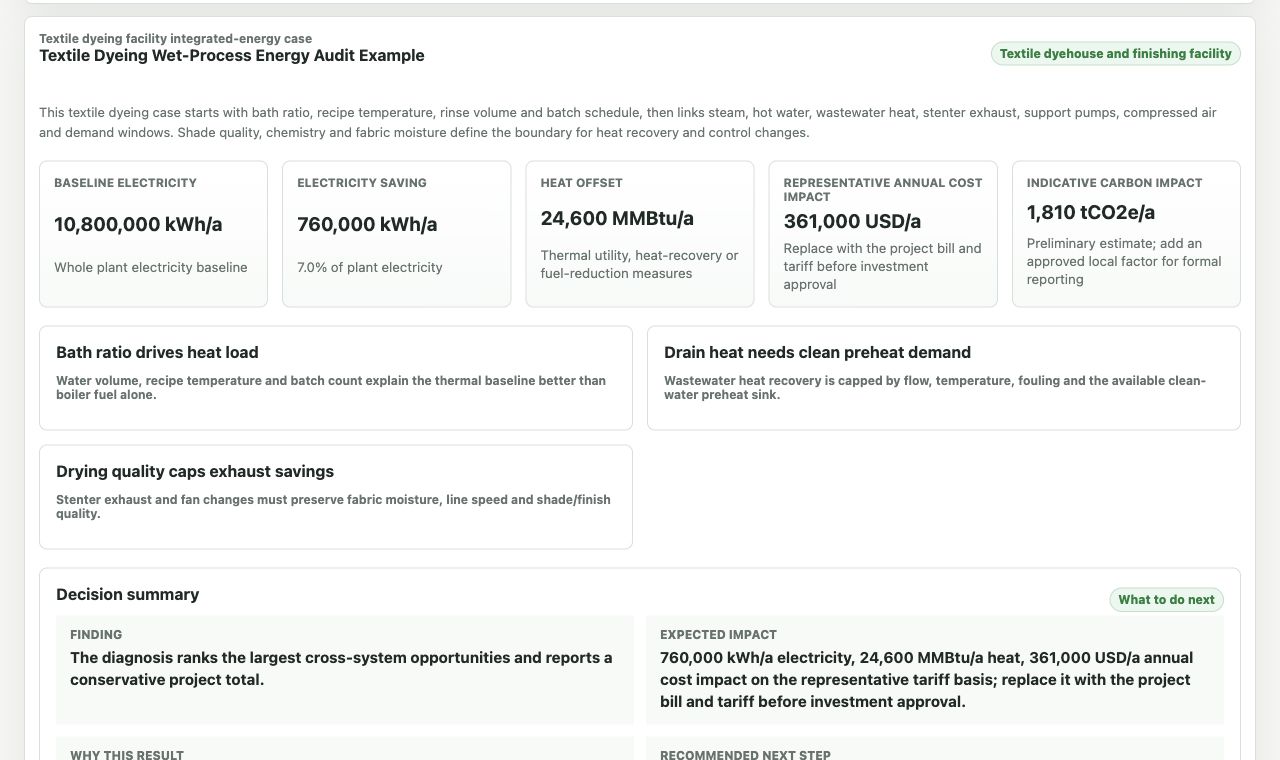
Actual diagnosis output
Dyeing, washing, drying and recoverable heat shown without double counting.
The report keeps chemistry, color quality, fouling and batch timing visible as decision boundaries.
Wet process boundary first
Textile dyeing energy is dominated by heating water and removing moisture.
The report starts from batch weight, bath ratio, dyeing temperature, washing, drying and wastewater discharge before assigning savings.
Large water flows create both heat demand and recoverable wastewater heat.
Dryer and stenter exhaust can carry useful heat but may be fouling/moisture limited.
Combustion, traps, condensate and insulation remain thermal-side measures.
Secondary electricity loads are reviewed separately.
Heat-recovery value depends on overlap between heat source and heat sink.
Diagnosis result structure
What the textile workflow produces.
The report separates process heat, boiler losses, wastewater heat recovery, exhaust heat, pump/fan energy and compressed air before summarizing project value.
Measure groupWhy it mattersEnergy boundaryData to improve confidence
Wastewater heat recovery
Hot discharge can preheat incoming process water.
Fuel/hot-water offset capped by sink demand.
Wastewater flow, temperature, fouling and cold-water demand.
Dryer or stenter exhaust recovery
Exhaust heat may preheat air or water.
Fuel offset, separate from boiler tuning.
Exhaust temperature, humidity and operating hours.
Boiler and steam distribution
Steam traps, condensate and insulation affect thermal losses.
Fuel reduction.
Steam meter, trap survey and condensate return.
Pumps, fans and compressed air
Secondary systems still affect operating cost.
Electricity saving.
Motor list, schedules, air pressure and compressor trend.
Quantification package
What must be measured before this becomes a decision-ready textile report.
The report quantifies wet-process heat, dryer exhaust, wastewater heat recovery, boiler losses and secondary electricity only after batch timing and water/steam data are connected.
Calculation layerRequired site dataMethod outputConfidence and M&V
Wet-process heat baseline
Batch weight, bath ratio, dyeing temperature, water flow, steam/fuel use and batch schedule.
Thermal baseline by dyeing, washing and hot-water preparation step.
Measured result with steam/water meters; engineering estimate with batch logs and fuel bills.
Heat recovery screen
Wastewater flow and temperature, dryer/stenter exhaust temperature and humidity, fouling risk and useful heat sink.
Recoverable heat capped by sink timing, temperature match and fouling boundary.
M&V uses heat-meter trend, wastewater trend, exhaust trend and product quality records.
Overlap control
Boiler tuning, condensate return, wastewater recovery and exhaust recovery assigned to separate heat sinks.
Fuel offset is separated from pump/fan and compressed-air electricity.
Color quality, chemistry and batch schedule remain required constraints.
Reference-backed method
Public method references behind this textile dyeing case.
These references are used as method context for audit structure, system boundaries, evidence quality and M&V planning. They do not confirm site savings; the workflow still requires site data before investment use.
Reference familyHow it supports this case
ISO 50002 / ISO 50001
Audit boundary, data quality, method basis and M&V path.
DOE steam and process-heating guidance
Wet-process heat, boiler, condensate, dryer/stenter exhaust and useful heat sinks.
Industrial heat-recovery engineering context
Bath ratio, wastewater temperature, fouling and product-quality caps.
Before running the workflow
What a dyehouse user can judge before running the workflow.
This page shows the industry-specific signals used in the detailed diagnosis report, so a visitor can judge relevance before entering site data.
Visible signalWhat it tells the user
Process signal
Bath ratio, recipe temperature, softening/finishing, fabric moisture and stenter speed are visible.
Energy signal
Wet-process heat, wastewater heat and stenter exhaust are separated from boiler tuning.
Boundary signal
Shade quality, chemistry and fouling cap the heat-recovery claim.
Use this textile case as a wet-process heat screen.
Start with steam, water, dryer exhaust and wastewater data, then improve confidence with batch logs. Use the example diagnosis to inspect the method, or start a clean diagnosis with your own facility data.