Room grades, pressure cascade and operating schedule define the airflow baseline.
Pharmaceutical cleanroom integrated-energy audit example
Cleanroom airflow, pressure cascade, humidity and reheat diagnosed as one GMP-constrained energy system.
This case starts from validated cleanroom operation: room grades, supply and exhaust airflow, humidity control, chilled water, steam/reheat, clean utilities, compressed air and batch schedules.
- Separates cleanroom airflow, chilled-water load, steam/reheat and compressed air before showing totals.
- Reports energy opportunities inside pressure, humidity and contamination-control limits.
- Lists the trend data needed before a result is used for investment approval.
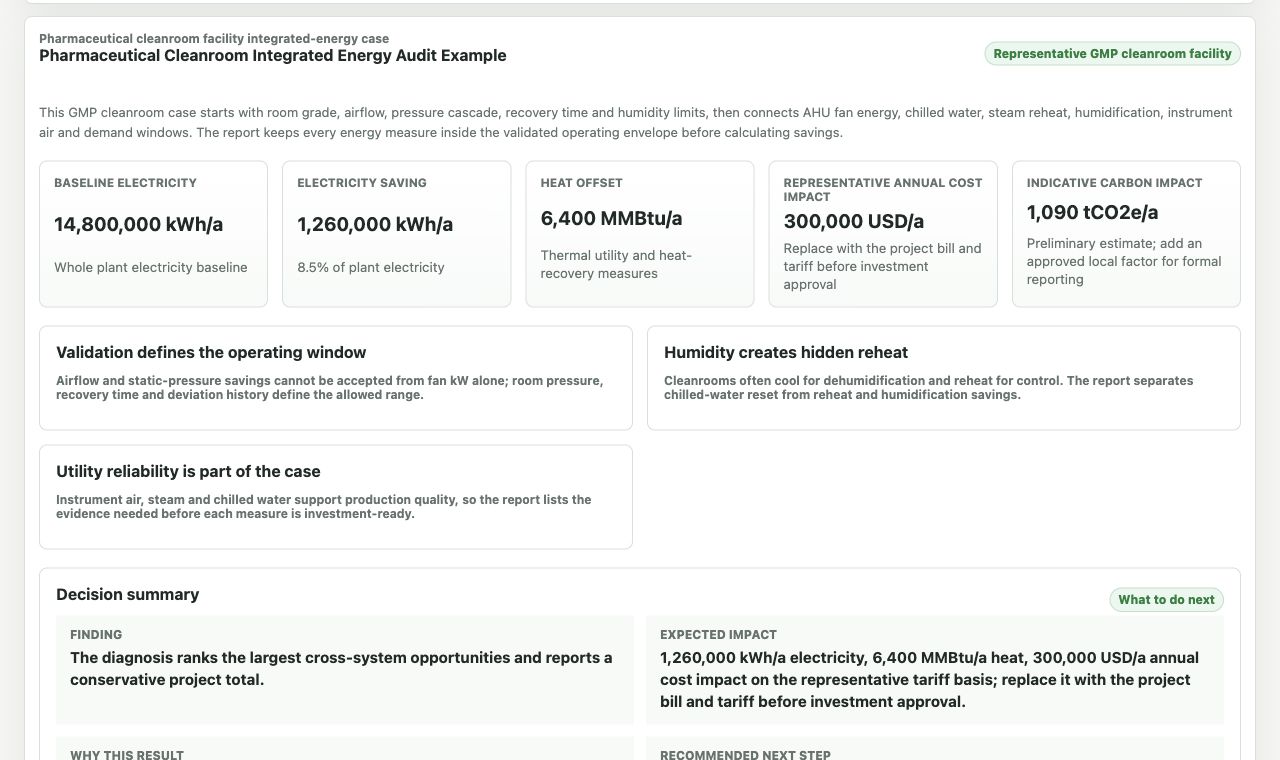
Actual diagnosis output
Airflow, humidity, reheat and utility savings inside the validated cleanroom boundary.
The report keeps every recommendation tied to pressure, recovery time, quality and evidence requirements.
Process boundary first
Cleanroom energy is controlled by air, moisture and compliance boundaries.
A cleanroom cannot be audited like a normal office HVAC system. Air-change rate, room pressure, humidity range, make-up air, filtration and validated recovery time decide which energy measures are acceptable.
Outdoor air and exhaust balance create fan, heating, cooling and humidity-control load.
Dehumidification and reheat can create simultaneous chilled-water and steam/hot-water demand.
Chilled-water temperature, coil approach and low-load operation affect both comfort and moisture removal.
Sterilization, humidification, cleaning and reheat loads are treated as thermal utilities.
Plant air for instruments, valves and packaging is reviewed as a secondary electricity measure.
Diagnosis result structure
What the cleanroom workflow produces.
The report separates HVAC electricity, chilled-water energy, reheat/steam utility, compressed air and compliance constraints before prioritizing measures.
Measure groupWhy it mattersEnergy boundaryData to improve confidence
Air-change and pressure-cascade review
Fan energy and conditioning load rise quickly with airflow.
Fan kWh plus cooling/reheat interaction, counted once.
Room airflow, pressure trend, recovery time and deviation logs.
Humidity and reheat optimization
Moisture control can drive simultaneous cooling and heating.
Chilled-water and steam/hot-water use separated before totals.
Humidity trend, coil data, reheat valve position and steam meter.
Chilled-water and AHU control
Temperature reset and coil performance affect dehumidification stability.
Chiller, pump and AHU electricity.
Chilled-water trend, coil approach and AHU schedule.
Steam and clean utility review
Reheat, humidification and sanitation loads can dominate thermal cost.
Fuel/steam reduction, not mixed with HVAC electricity.
Steam meter, trap survey, condensate return and utility schedule.
Compressed air pressure and leakage
Instruments and packaging need reliable air but not excessive pressure.
Secondary compressor electricity saving.
Compressor power, pressure trend, dryer type and leak survey.
Evidence basis
Public references support the cleanroom energy boundary.
The page exposes the method basis instead of claiming a named customer project.
Supports HVAC, motors, compressed air, boilers and process utility opportunity framing.
Open public referenceSupports pressure, leakage, dryer loss and compressor-system review.
Open public referenceThe workflow is designed for room airflow, pressure, humidity, chilled-water, steam and compressed-air data from the user site.
Quantification package
What must be measured before this becomes a decision-ready cleanroom report.
The pre-audit quantifies opportunity only after the cleanroom boundary, utility meters and operating constraints are connected. The case defines the calculation basis before any measure is treated as decision-ready.
Calculation layerRequired site dataMethod outputConfidence and M&V
Cleanroom HVAC baseline
Room grade, area, ACH, supply/exhaust airflow, fan power, operating hours and AHU schedule.
Fan kWh and conditioning load boundary by room group.
Screening with nameplate data; measured result with BAS trend and power meter.
Humidity and reheat penalty
Humidity trend, chilled-water supply/return, reheat valve position, steam/hot-water meter and deviation limits.
Separated chilled-water and thermal penalty, with simultaneous cooling/heating flagged.
Engineering estimate until coil and reheat trends are available.
Overlap control
Airflow, static pressure, chilled-water reset and reheat measures mapped to the same AHU boundary.
Fan, cooling and reheat savings are counted once before the project total.
M&V uses AHU kW, airflow, humidity and utility-meter trend before and after change.
Reference-backed method
Public method references behind this pharmaceutical cleanroom case.
These references are used as method context for audit structure, system boundaries, evidence quality and M&V planning. They do not confirm site savings; the workflow still requires site data before investment use.
Reference familyHow it supports this case
ISO 50002 / ISO 50001
Audit process, data quality, report structure and energy-performance context.
ISO 14644 cleanroom context
Room classification, controlled-environment boundary and particle-control context.
FDA cGMP aseptic-processing context
Validated operation, pressure cascade, deviation records and quality boundary.
Before running the workflow
What a GMP cleanroom user can judge before running the workflow.
This page shows the industry-specific signals used in the detailed diagnosis report, so a visitor can judge relevance before entering site data.
Visible signalWhat it tells the user
Process signal
ACH, room grade, pressure cascade and recovery time are named with the airflow measure.
Energy signal
Humidity, reheat, chilled water and clean utilities are not merged into one HVAC number.
Boundary signal
Deviation history and approved RH limits gate control changes.
Use this cleanroom case as a pre-audit starting point.
Start from the cleanroom workflow, then replace the sample method inputs with your own room, utility and trend data. Use the example diagnosis to inspect the method, or start a clean diagnosis with your own facility data.