Load weight and fixture mass affect useful heat and cycle intensity.
Metal heat treatment mature boundary case
Furnace cycles, exhaust heat, quench cooling and auxiliary loads screened inside metallurgy and quality limits.
This case starts from furnace type, load weight, cycle temperature, soak time, exhaust temperature, quench cooling and production schedule before screening energy measures.
- Separates furnace heat, auxiliary electricity, quench cooling and demand charge.
- Screens exhaust/flue heat recovery without changing validated recipes.
- Keeps metallurgical quality and quench curve requirements as hard boundaries.
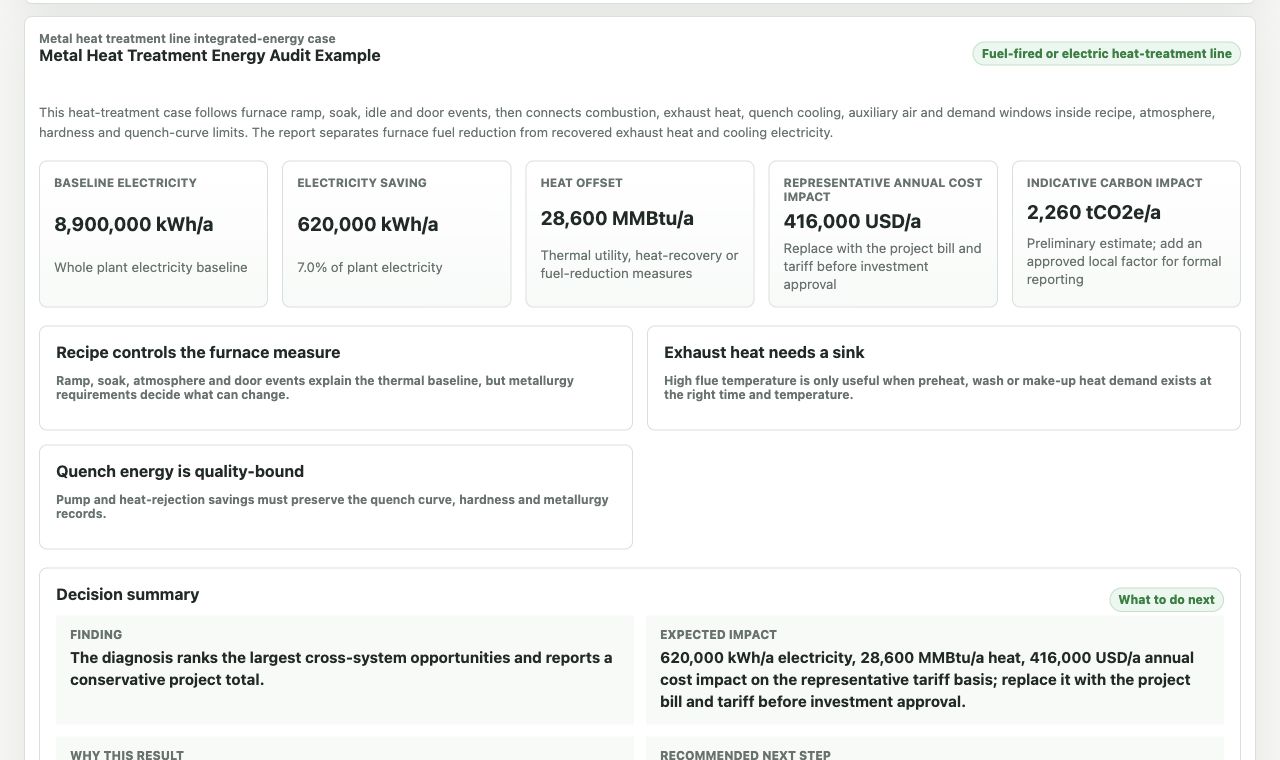
Actual diagnosis output
Furnace cycles, exhaust heat and quench cooling inside metallurgy limits.
The report ranks energy measures without changing validated temperature, soak or quality requirements.
Cycle boundary first
Heat-treatment energy is tied to load, cycle and material quality.
The report defines the furnace and cycle boundary before evaluating combustion, electric heat, insulation, door losses, exhaust heat, quench cooling and demand.
Temperature and soak time define the process requirement.
Wall losses, door losses, excess air and exhaust temperature drive waste.
Atmosphere, doors and exhaust are process constraints.
Quench pumps and cooling must preserve product quality.
Preheat and recovery are evaluated only where a useful sink and quality boundary exist.
Diagnosis result structure
What the heat-treatment workflow produces.
The report shows furnace baseline, cycle intensity, combustion/electric heating losses, exhaust heat, quench cooling and implementation constraints.
Measure groupWhy it mattersEnergy boundaryData to improve confidence
Combustion or electric heating review
Furnace efficiency depends on excess air, controls, elements and cycle utilization.
Fuel or electric heat reduction.
Fuel/electric meter, O2, exhaust temperature and cycle logs.
Insulation, seals and door losses
Heat escapes through walls, doors and poor sealing.
Fuel/electric heat, separate from burner tuning.
Thermal inspection, door cycle and maintenance records.
Exhaust heat recovery
Flue or exhaust heat may preheat air, load or water.
Thermal offset, capped by useful sink.
Exhaust temperature, flow and sink temperature.
Quench and auxiliary control
Pumps, fans and cooling systems add electrical load.
Auxiliary kWh and demand charge.
Quench flow, temperature, pump power and schedule.
Quantification package
What must be measured before this becomes a decision-ready heat-treatment report.
The report quantifies furnace heat, exhaust losses, quench cooling, auxiliaries and demand only after the cycle profile and metallurgy boundaries are defined.
Calculation layerRequired site dataMethod outputConfidence and M&V
Furnace cycle baseline
Furnace type, load weight, fixture mass, ramp/soak temperature, soak time, fuel/electricity input and operating schedule.
Useful heat, standby/holding loss, exhaust loss and cycle energy intensity.
Measured result with furnace meter and cycle log; engineering estimate with recipe and utility records.
Exhaust recovery and quench auxiliaries
Exhaust temperature/flow, combustion O2 where relevant, useful heat sink, quench flow, pump/fan kW and cooling-water trend.
Thermal recovery screen plus auxiliary kWh opportunity.
M&V uses stack/exhaust trend, fuel/electric meter, quench trend and product quality records.
Overlap control
Combustion tuning, insulation/seals, exhaust recovery and auxiliary control assigned before totals.
Fuel or electric heat reduction is separated from quench and auxiliary electricity.
Metallurgical recipe and quench curve requirements remain hard boundaries.
Reference-backed method
Public method references behind this metal heat-treatment case.
These references are used as method context for audit structure, system boundaries, evidence quality and M&V planning. They do not confirm site savings; the workflow still requires site data before investment use.
Reference familyHow it supports this case
ISO 50002 / ISO 50001
Audit boundary, method basis, evidence quality and M&V structure.
DOE process-heating sourcebook
Furnace cycles, combustion, insulation, door losses, exhaust heat and useful heat sinks.
Metallurgy / quality-review context
Recipe, atmosphere, quench curve, hardness and load pattern before energy changes.
Before running the workflow
What a heat-treatment user can judge before running the workflow.
This page shows the industry-specific signals used in the detailed diagnosis report, so a visitor can judge relevance before entering site data.
Visible signalWhat it tells the user
Process signal
Batch, continuous and atmosphere furnace paths are declared as sub-profiles.
Energy signal
Furnace cycle, exhaust recovery, quench cooling, auxiliary air and demand remain separate streams.
Boundary signal
Atmosphere, quench curve, hardness and recipe limits gate every measure.
Use this heat-treatment case as a furnace-energy screen.
Start with furnace type, load, cycle, exhaust and quench data before treating any measure as decision-ready. Use the example diagnosis to inspect the method, or start a clean diagnosis with your own facility data.